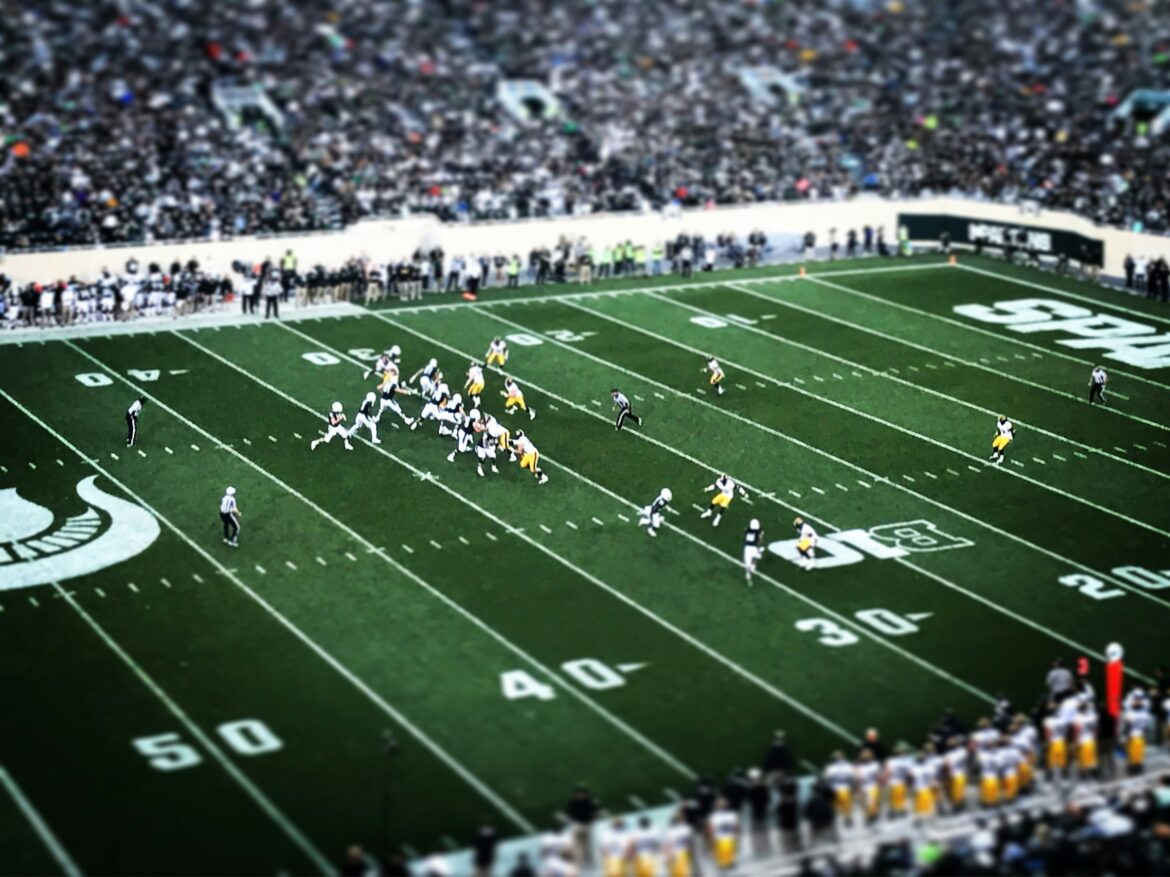
While some American professional sports leagues have secured strong fandoms in the United Kingdom, American college sports have struggled to make a lasting impression. Perhaps, in hopes of jump starting that fandom, that is why London will see a American college football game this year for the first time since the 1980s.
The Arizona State Sun Devils will be facing off against the Kansas Jayhawks in the first installment of the Union Jack Classic. The game will take place on Sept. 19 at Wembley Stadium, which has seen its fair share of NFL matchups.
In some respects, it is surprising that American college football isn’t as popular in the United Kingdom. If anything, it is the American sport that most closely resembles the professional football leagues found in Europe.
Each game carries a sense of urgency and importance. Seasons are short (teams are only guaranteed 12 games) and a bad loss may sink a team’s chances at playing for a national championship. Also, players can only play in college for so long, meaning that games have an additional importance to each of the players.
American college football is a deeply regional sport. Different conferences—which are similar to the different leagues in Europe—have their own styles and traditions shaped by the culture of that area.
For example, teams from the American Midwest tend to emphasize strong offensive and defensive line play. These teams typically play slow, plodding games that reward sound technique, but also brute strength. This grueling style was born out of the colder weather and inclement conditions that forced teams to abandon higher octane offenses in favor of a more tried and true method.
Over time, this sort of thing becomes part of a team’s identity and is often hard to shake. What was once an adaptation, then becomes tradition. And that tradition element, is a key part to the mystique of American college football.
From the Fighting Irish hitting the sign at Notre Dame, to Sooner Schooner at Oklahoma, and “White Out” at Penn State—it’s cliche to say, but it’s the traditions that make American college football special.
Some are sweet, like “The Wave” at Iowa Hawkeye games, where both teams and the fans wave to the children at the children’s hospital overlooking the stadium. Some are historic like the Clemson Tiger’s game-day entrance. And some are plain sports magic like night games at LSU’s Tiger Stadium.
This traditional aspect is foundational to American college football. Like an heirloom, fandom of a team is passed down through a family. It’s hard to overstate just how tied to a specific team a single family can be. University alumni routinely go back and visit their old schools to cheer on their teams.
It’s a level of obsession and tribalism that is, frankly, akin to football in Europe. Rivalries are rampant. States, and homes, are divided along these grounds. Sometimes, beating a rival team is the ultimate indicator of the season being a success or failure. While the last week of the regular season culminates in “Rivalry Week,” these highly contentious games are planned throughout the season.
These games are like circuses. The biggest rivalries have their own ecosystem of coverage around them. They are little football galaxies all to themselves. Michigan-Ohio State, Texas-Oklahoma, Alabama-Auburn—these games are effectively their own holidays.
This vitriol extends beyond just teams. The conferences often hate each other too. The Southeastern Conference thinks that the best football played within their borders, and likewise, the Big Ten thinks the same. There’s little reason for the individual fan to care about these larger dynamics but because of how embedded they are with their own teams, anyone who dares throw a slight their way is perceived as an enemy.
But the ultimate reason why American college football separates itself from professional sports leagues is sheer unpredictability. At times, the outcomes of games can feel like a dice roll. Teams rely on 18–22-year-olds to win their games, and being so young, they can often lose focus week-to-week.
That is the fundamental ingredient in the art of the upset. Anyone can beat anyone. That’s how a seemingly anonymous team like the Appalachian State Mountaineers can waltz into the Big House and beat a traditional powerhouse in the Michigan Wolverines.
This past season, the Indiana Hoosiers won the national championship. Indiana was perhaps the worst American college football program of all time. Their program’s history is sparse; there has been very little to celebrate. They were a joke to the American college football world and seen as an easy win. But the Hoosiers went undefeated en route to winning a title.
That is the ultimate allure of American college football. Yes, the pageantry, passion, and tradition add to the charm, but it’s these David and Goliath stories that truly make American college football worth watching.