
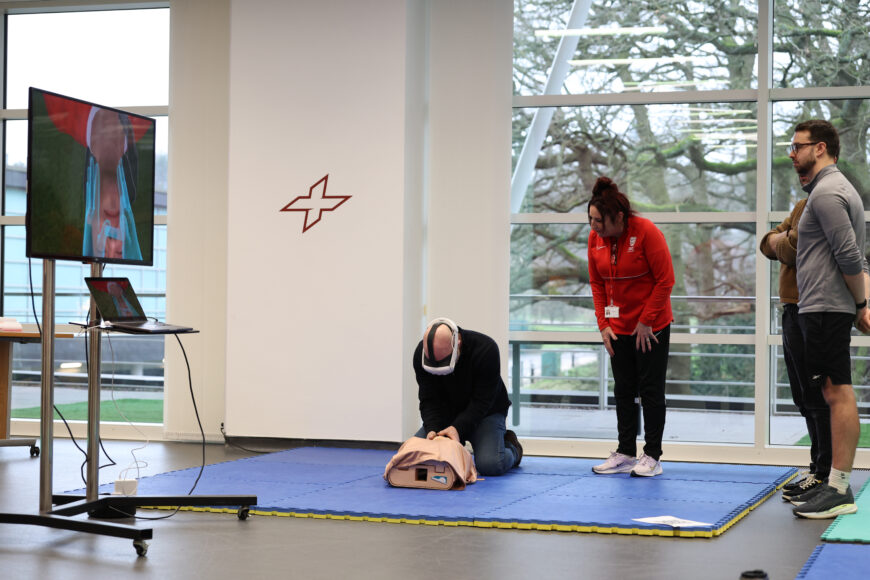
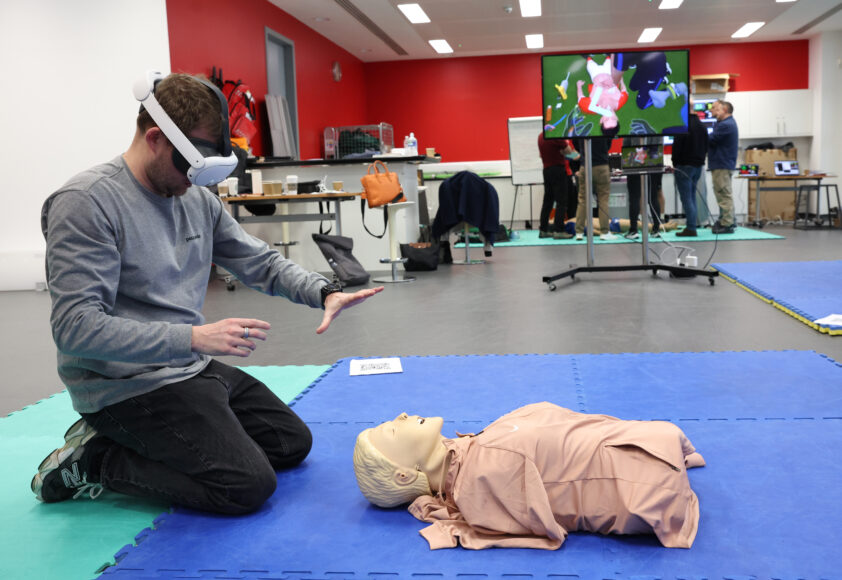
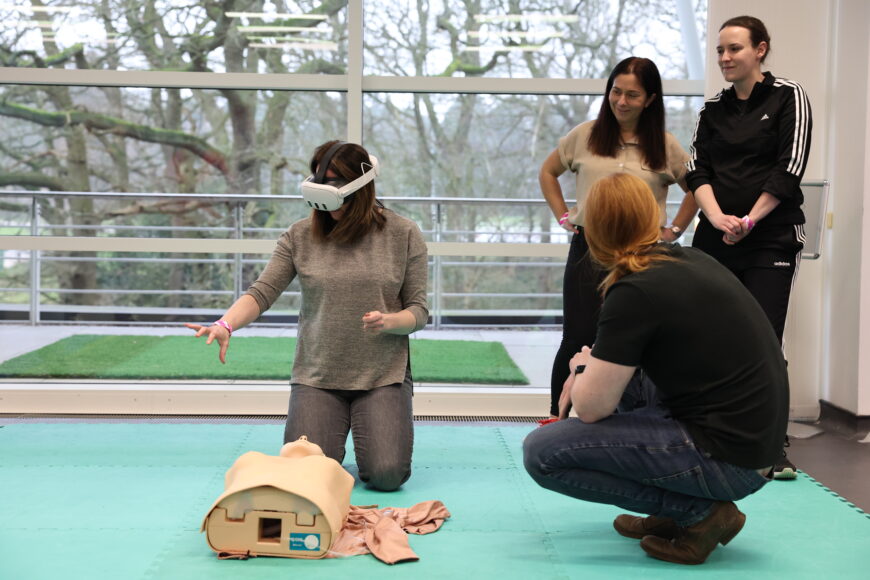
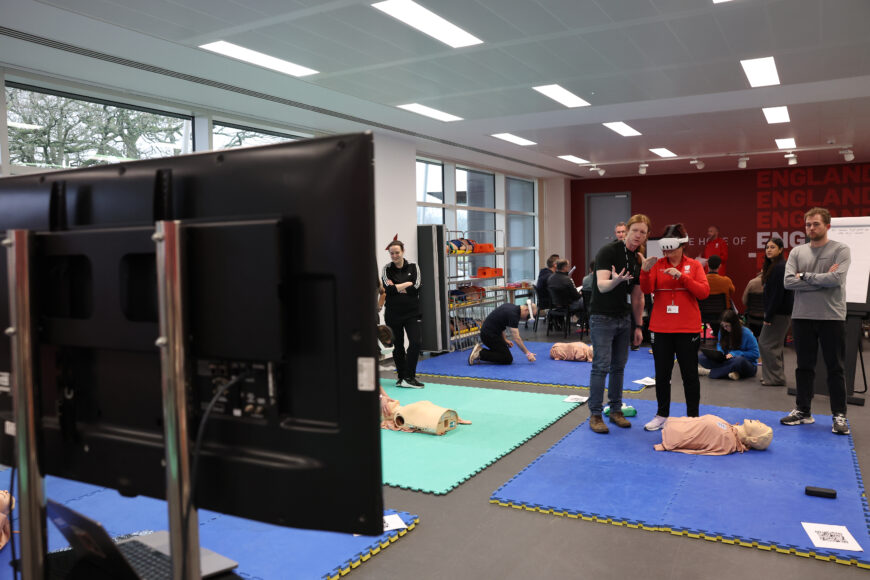
England Football Learning is set to revolutionise medical education in football with the introduction of cutting-edge virtual reality (VR) technology into its CPR training programmes from March. The move marks a significant step forward in immersive and augmented learning within football medicine — raising standards in player care across the game.
Piloted at St George’s Park over two days, the new VR training experience saw more than 80 medical tutors and practitioners take part. Their feedback helped refine the technology ahead of its national rollout.
Bringing Stadium Pressure into the Classroom
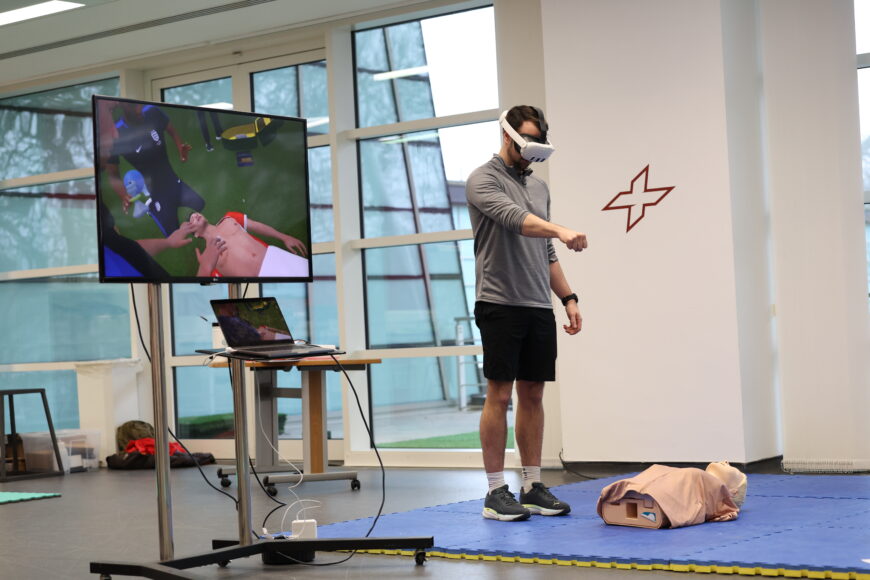
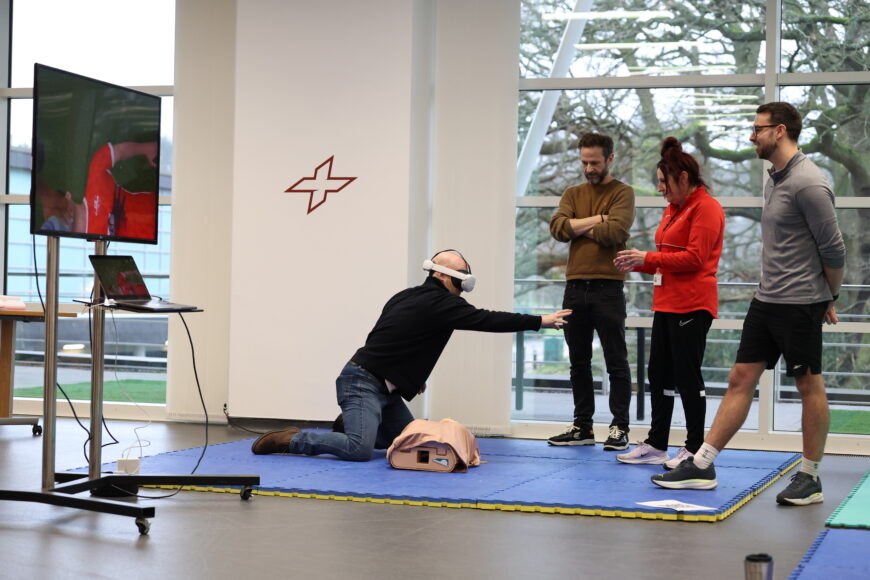
The VR element has been carefully designed to complement — not replace — traditional CPR training. Integrated into a 40-minute CPR station, the immersive scenario lasts approximately eight minutes and places learners in a highly realistic football environment.
Wearing a VR headset while physically working on a mannequin, participants are transported into a virtual stadium setting complete with crowd noise, live commentary, referees and on-pitch distractions — factors that cannot be replicated in a conventional classroom.
Unlike assessment-based simulations, the experience focuses entirely on skill reinforcement. Audio prompts and virtual assistance guide learners through the scenario, encouraging leadership, clear communication and confident decision-making under pressure. Participants must physically interact with equipment, deliver instructions to others and perform CPR techniques while remaining focused despite intense surrounding noise.
As we’ve explored previously in our coverage of sport and innovation at VERGE Magazine, immersive learning is increasingly reshaping professional training environments — and football medicine is no exception.
Rolling Out Across England Football Learning’s Medical Pathway
From March, the VR CPR module will initially be introduced into England Football Learning’s ATMMiF and ITMMiF courses, with long-term plans to expand the technology across its entire medical education pathway.
The initiative forms part of a broader Medical Education Strategy aimed at integrating high-fidelity simulation into football healthcare training. The ambition is to support learners with sequencing, decision-making and order during life-like emergency situations — without the risks associated with real-world scenarios.
Professor Lisa Hodgson, Medical Education Senior Lead at England Football Learning, explained:
“This is about augmenting what we already do. CPR is a psychomotor skill – you have to physically do it. Virtual reality gives us the realism we simply can’t recreate in a classroom, such as crowd noise, pressure and human factors, while still allowing learners to perform CPR on a real mannequin. It adds another layer of fidelity to the learning experience.”
By embracing virtual reality, England Football Learning is positioning itself as a global leader in football medical education — setting a new benchmark for immersive clinical training.
Developed in Collaboration with Portico and Sheffield University
The programme was developed in collaboration with Portico, described as the home of VR learning, following early research discussions with the Advanced Manufacturing Research Centre at the University of Sheffield.
Over eight months, England Football Learning and Portico worked closely to develop the experience. The process began with detailed scripting, including avatar dialogue and equipment requirements. From there, teams built a realistic stadium atmosphere — carefully engineering crowd noise, commentary and environmental detail to replicate matchday pressure.
One of the most innovative features is the advanced hand-tracking technology. Rather than using traditional VR controllers, learners perform CPR directly on a mannequin while wearing the headset — bridging the gap between immersive digital simulation and hands-on clinical skill.
Justin Parry of Portico said:
“Lisa had a very clear vision – this wasn’t about gamification, it was about placing learners onto a football pitch with all the stress, noise and distraction that comes with it, while still walking them through the correct processes. We worked closely with The Football Association (The FA) to script the virtual reality scenario and build an experience that feels authentic and purposeful.”
Raising Standards in Player Care
As football continues to prioritise player welfare, advancements like VR-enhanced CPR training signal a broader shift towards immersive, technology-driven education. High-fidelity simulation is increasingly recognised across healthcare as a powerful tool for building confidence, competence and clarity under pressure.
For England Football Learning, this innovation underscores a clear commitment: preparing medical professionals to deliver the very best player care — whether in grassroots football or elite competition.
Readers can explore more about professional medical and coaching pathways via the official England Football Learning course portal.


