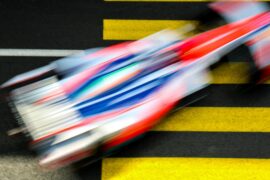
Oracle Red Bull Racing has taken Formula 1 somewhere it has never been before – underground, with its iconic RB8 racing through the Madrid Metro ahead of the return of the Spanish Grand Prix.
Formula 1 cars are built for speed, but Oracle Red Bull Racing has proved that the RB8 can handle a very different kind of track.
To celebrate the return of the Spanish Grand Prix to Madrid after 45 years, Red Bull Racing took its championship-winning RB8 onto the rails of the Madrid Metro in a spectacular first-of-its-kind engineering stunt.
The history-making project saw the iconic F1 car transformed into a train, with the ambitious challenge documented in a new short film.
From F1 Circuit to Madrid Metro
The project brought together Oracle Red Bull Racing’s Heritage Team and Spanish engineering and creative collective Andtonic, who were tasked with figuring out how to get an F1 car safely onto railway tracks.
The challenge began at the Canillejas Metro workshops, where the teams designed and manufactured bespoke metal wheels specifically for the RB8.
Weighing 29.8kg each, the custom wheels were around twice the weight of a standard F1 wheel. They had to be engineered carefully enough to allow the RB8 to travel along the Madrid Metro while protecting the car’s delicate suspension, gearbox and drivetrain components.
The result was an extraordinary hybrid of motorsport and railway engineering.
Patrick Friesacher Gets Behind the Wheel
Former F1 driver Patrick Friesacher was given the unusual task of taking the RB8 onto the tracks.
During a controlled closure of the Madrid Metro network, Friesacher piloted the specially adapted F1 car through the underground system, passing locations including Estadio Metropolitano, as well as the Sacedal and Chamartín depots.
Speaking about the experience, Friesacher described driving an F1 car on railway tracks as surreal.
“It was an unbelievable experience. I’ve been lucky enough to experience a lot with our Heritage team, but driving an F1 car on railway tracks was surreal.”
He joked that he could now add “Metro driver” to his CV.
The stunt continues Red Bull Racing’s long-running reputation for taking Formula 1 machinery into unexpected environments. The team has previously taken its cars to some of the world’s most unusual locations, but putting an F1 car on an underground railway represents a particularly ambitious engineering challenge.
Why Is F1 Returning to Madrid?
The spectacular stunt comes just days before the 2026 Spanish Grand Prix, which will mark Formula 1’s return to Madrid for the first time since 1981.
The new Madring circuit will provide the setting for the race, with a new Metro station being built within the circuit complex to help thousands of fans travel to and from the event.
That makes the Metro a particularly fitting part of Red Bull Racing’s Madrid arrival – although most fans will have to settle for travelling on a normal train.
Oracle Red Bull Racing has published the full story behind the project, including the engineering challenges involved in transforming the RB8 for its unusual journey. Watch Red Bull Racing’s full ‘On Rails’ story
The RB8 Returns to the Rails
The RB8 is particularly significant in Red Bull Racing history. The car powered Sebastian Vettel to his third Formula 1 World Championship in 2012, helping cement one of the team’s most successful periods in the sport.
Now, more than a decade later, the RB8 has found itself facing a completely different kind of challenge.
From the Formula 1 circuit to the Madrid Metro, Red Bull Racing’s latest stunt demonstrates just how far the team’s engineering expertise can be pushed.
And with the Spanish Grand Prix returning to Madrid, the RB8’s underground adventure provides a suitably dramatic way to welcome F1 back to the capital.
For more Formula 1 coverage, check out Verge Magazine’s previous coverage of Oracle Red Bull Racing and our latest Formula 1 features.