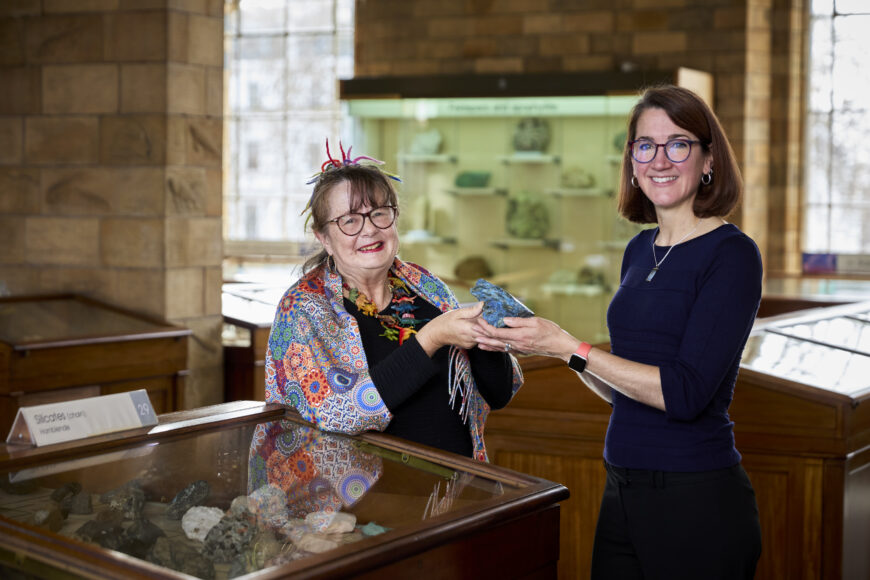


A once-mysterious blue mineral that puzzled scientists for decades is now finally on public display at London’s Natural History Museum—and its story is as fascinating as its striking colour.
A Scientific Mystery Decades in the Making
First analysed in 1996 after being brought to the Museum by broadcaster and geologist Anna Grayson, the vivid blue specimen immediately sparked curiosity. Experts at the time, led by the late Dr Gordon Cressey, were unable to identify it—raising the exciting possibility that it could be entirely new to science.
The mineral was initially thought to be a mixture of different substances. Crucially, it also lacked an entry in the International X-ray Diffraction Database, making identification even more challenging.
It wasn’t until years later that scientists confirmed the mineral as aerinite, a rare and complex carbonate-bearing silicate known for its intense sky-blue hue.

From Moroccan Roadside Find to Museum Centrepiece
The journey of this mineral began long before it reached London. In 1980, Grayson discovered the specimen at a roadside stall south of Fez. The seller believed it to be lapis lazuli, but its unusual electric-blue tone suggested otherwise.
Recognising its uniqueness, Grayson brought the mineral to the Museum during a public identification event in 1995. What followed was over a year of intensive analysis, as researchers worked to decode its unusual properties.
Unlocking the Secrets of Aerinite
Using advanced techniques such as synchrotron X-ray analysis, scientists were able to unravel the mineral’s composition. Aerinite is made up of millions of microscopic crystal fibres, each thinner than a fraction of a human hair.
Its mesmerising blue colour comes from the interaction between two types of iron atoms—Fe²⁺ and Fe³⁺—within the structure. As light hits the mineral, electrons move between these atoms, absorbing specific wavelengths and producing its vivid blue appearance. Depending on the angle of light, the mineral can even appear colourless or shift in intensity.
Although aerinite was first named in 1876, its complex atomic structure wasn’t fully understood until 2004, when a research team led by Jordi Rius in Barcelona finally solved it using newly developed analytical methods.
Why This Discovery Still Matters
According to Dr Paul Schofield, the study of this specimen didn’t just solve a mystery—it pushed the boundaries of mineral science.
The research helped scientists reclassify other unknown samples within the Museum’s collection and contributed to broader advancements in analytical technology. These innovations continue to play a role in fields such as materials science and the global energy transition.

Now on Display in London
Visitors can now see the remarkable aerinite specimen in person at the Museum’s Minerals Gallery—home to some of the world’s rarest geological treasures. Entry to the gallery is free, making it an accessible stop for anyone interested in science, history, or natural beauty.
Learn more at: https://www.nhm.ac.uk/
From a roadside curiosity in Morocco to a scientific breakthrough in London, aerinite’s journey is a reminder that even the smallest discoveries can reshape our understanding of the natural world.